
If you’re here because you’ve been quietly asking questions you haven’t said out loud at work — you’re in the right place.
The LGB Courage Coalition is a lesbian and gay advocacy organization founded and led by gay men, lesbians, and bisexual people — including physicians, clinicians, and researchers — who believe the evidence in pediatric gender medicine does not support current practice. We were founded in 2023 in the wake of whistleblower testimony from a clinical research coordinator at a major pediatric gender clinic, and we have spent the time since 2023 working at the intersection of evidence-based medicine, gay and lesbian civil rights, and accountability in pediatric care.
Our medical director is a board-certified OB-GYN and former state section chair of a major national medical association who resigned her leadership position after raising a formal fraud allegation against the world’s leading pediatric gender medicine body. This page is our attempt to meet fellow clinicians where they are.
We are not asking you to agree with us. We are asking you to look at the evidence — and to consider whether the professional consensus you were handed holds up when you examine how it was built.
The questions below are the ones we hear most often from healthcare professionals encountering this conversation for the first time.
FAQ for Healthcare Professionals
I’m an expert in my own field of medicine. How am I in a position to evaluate another specialty — isn’t that overstepping? Don’t the specialists in this area know best?
This is a reasonable professional instinct, and in most areas of medicine it is the correct one. Deferring to specialists reflects intellectual humility and appropriate recognition of the limits of one’s own training. In the case of pediatric gender medicine, however, that instinct has been systematically exploited — and the questions at the center of this controversy are not, in fact, specialty-specific.
The foundational questions here are methodological ones that any trained clinician can evaluate: Are the studies randomized or controlled? Are the outcomes measured rigorously and over sufficient time? Has the evidence been subjected to independent systematic review? Is the patient population on which early findings were based comparable to the population now being treated? These are not questions that require subspecialty expertise in gender medicine to answer. They are the questions a well-trained physician in any field asks of any evidence base.
When every independent national health authority that has commissioned a systematic review — in the United Kingdom, Sweden, Finland, Denmark, and Norway — has reached the same conclusion about insufficient evidence, that finding is not the opinion of outsiders overstepping into a specialized field. It is the result of applying universal standards of evidence to a body of literature and finding it wanting. Dr. Hilary Cass, whose review is the most comprehensive ever conducted in this area, is a pediatrician — not a gender specialist. Her qualification was her expertise in evidence evaluation and child health, not subspecialty training in gender medicine.
It is also worth noting that many of the clinicians raising the most serious concerns about pediatric gender medicine are specialists in directly relevant fields: pediatric endocrinology, adolescent psychiatry, reproductive medicine, and pediatrics itself. The argument that concern about this evidence base represents a category error — non-experts meddling where they don’t belong — does not survive contact with the actual roster of critics.
Deference to authority is appropriate when that authority has been earned through rigorous, reproducible science. It is not appropriate when the authority being invoked was built on consensus rather than evidence — and when the specialists claiming that authority are the same ones who constructed the consensus in the first place.
Isn’t this just a political culture war issue? Is there really a reason to be alarmed?
It has become a political issue. That does not make it only a political issue, and the conflation of those two things has done serious harm to the ability of the medical community to examine the evidence clearly.
The political weaponization has run in both directions. Legislation restricting pediatric gender medicine has in some cases been drafted and advanced by people whose primary motivation is cultural rather than evidentiary. At the same time, the clinical concerns that gave rise to this controversy — insufficient evidence, inadequate follow-up, absence of randomized controlled trials, failure to track outcomes — predate the current political moment and were first raised from within the medical community by clinicians and researchers with no political agenda. The Swedish, Finnish, Danish, Norwegian, and British reviews that found the evidence base insufficient were commissioned by left-leaning national health systems, conducted by researchers without identifiable ideological commitments to either side of this debate, and produced through the same methodological processes those systems apply to any clinical question. None of them were politically motivated. All of them reached the same conclusion.
There are specific, concrete clinical signals that should concern any physician regardless of political orientation. Gender clinics that were among the pioneers of this care — the Tavistock in the United Kingdom, and equivalent programs across Scandinavia — have been closed or substantially restructured by their own health systems following independent review. That is not a political outcome. It is a regulatory and clinical one. Detransitioners are pursuing medical malpractice litigation in multiple countries, alleging that they were treated without adequate informed consent and without sufficient evaluation of alternative explanations for their distress. Peer-reviewed literature has identified signals of harm — in bone density, neurological development, fertility, and suicide rates — that were not present in the original cohort data used to justify widespread adoption of these treatments. These are not talking points. They are findings in indexed journals.
The question of whether children are being harmed by a medical intervention is a medical question. It has a medical answer.
The fact that political actors have attached themselves to that question on both sides does not change what the evidence shows — and it does not relieve clinicians of the professional obligation to look at it.
This affects a very small number of patients. Isn’t the level of alarm disproportionate — and isn’t this really just an effort to make a vulnerable group of young people into a political target?
The premise that this affects a very small number of patients is no longer accurate, and the change in that number is itself one of the most important clinical signals in this entire controversy.
For most of the twentieth century, gender dysphoria was genuinely rare — presenting predominantly in young males, typically with early childhood onset, and at rates estimated between 1 in 10,000 and 1 in 30,000. The Dutch protocols that form the original evidence base for pediatric medical transition were developed for that population. What has happened since is not a stable rare condition being treated at appropriate scale. Between 2010 and 2020, referrals to pediatric gender clinics increased by 1,000 to 5,000 percent across the United Kingdom, Sweden, Finland, the Netherlands, and the United States. The demographic profile of those referrals shifted dramatically — from predominantly young males with childhood-onset dysphoria to predominantly adolescent females, most with no prior history of gender nonconformity in childhood and many with co-occurring mental health diagnoses. This is not a stable clinical picture being treated more efficiently. It is a new and poorly understood clinical phenomenon being treated with protocols developed for a different one.
In medicine, a rapid and unexplained increase in the incidence of a condition is a signal. It prompts questions, not answers. It calls for epidemiological investigation, careful diagnostic evaluation, and particular caution about irreversible interventions — not the acceleration of treatment pathways. The appropriate clinical response to a tenfold increase in referrals for a condition that was previously rare is not to scale up treatment. It is to ask what is driving that increase and whether the original diagnostic framework still applies.
As for the suggestion that concern about this evidence base is an effort to target a vulnerable population: the reviews that found the evidence insufficient were commissioned to protect patients, not to harm them. The clinicians who have raised alarms — including those who formerly worked inside gender medicine programs — did so because they were concerned about the young people in their care. The detransitioners pursuing litigation are not political actors. They are former patients who allege they were harmed. Attending to their experience is not targeting a vulnerable group. It is listening to one.
The most effective way to protect any patient population — including young people experiencing genuine distress about their sexed bodies — is to ensure that the treatments they receive are grounded in rigorous evidence, that the risks are accurately communicated, and that clinicians are not pressured to foreclose diagnostic inquiry in the name of affirmation. That is not a disproportionate ask. It is the minimum standard of care.
Doesn’t gender-affirming care reduce the risk of suicide?
This is so commonly repeated that it has almost become a truism; however, there is no evidence that it is true, and in fact there may well be causality in the opposite direction. Obviously, if pediatric gender medicine were actually life-saving and benefited young people, we would support it. Although the threat of adolescents committing suicide was used for years to justify pediatric gender medicine, the idea that pediatric gender medicine could prevent suicide was only ever conjecture. Even its most ardent proponents have admitted in recent years that there is no evidence to make such a claim. For example, even ACLU attorney Chase Strangio, arguing in favor of pediatric gender medicine before the Supreme Court, admitted that there was no evidence that these treatments prevented suicide.
We do know that adolescents who have been diagnosed with gender dysphoria have higher rates of suicidal thoughts, self-harm, and suicide attempts than the general population. These patients absolutely need mental health support and resources. However, we also know that these young people are more likely to have other co-existing mental health disorders. Therefore, we do not yet know whether gender dysphoria itself causes these increased suicidal thoughts.
There is some research that shows gender dysphoria in and of itself does not increase risk of completed suicide. The best evidence for this comes from Finland, where the national health system is able to track patients longitudinally. Of note, Finland has a high index of gender equity, so gender non-conforming young people in Finland are less likely to be negatively affected by homophobia and misogyny than nearly anywhere in the world. When psychiatric comorbidities were controlled for, adolescents with gender dysphoria were no more likely to die by suicide than age-matched controls.
Significantly, treating gender dysphoria with medications and surgery in adolescents does not decrease the risk of suicide. A systematic review on the topic found that “the overall quality of evidence was low and the risk of bias high. Further high-quality studies are needed.”
It must also be mentioned that the constant invoking of the risk of suicide runs counter to best practices in suicide prevention. Telling young people that they are at risk of suicide if they do not receive cross-sex hormones and surgeries can make it a self-fulfilling prophecy. According to an independent report from the UK government, the way this issue has been discussed publicly “has been insensitive, distressing and dangerous, and goes against guidance on safe reporting of suicide.”
There are some emerging signals that young people undergoing medical gender transition may be at higher risk of completed suicide. In a clinical trial of 315 adolescents receiving puberty blockers, two of the study subjects died by suicide within one year of initiating hormones, representing an annualized suicide rate of 317 per 100,000 patients.
In terms of adults, a Swedish registry study — notable for its rare capacity for long-term follow-up — found that adults who had medically transitioned had 19 times the rate of suicide deaths compared to controls. This study is now over a decade old and reflects an earlier patient population; it is included here because population-level registry data of this kind remains uncommon.
Aren’t puberty blockers completely reversible?
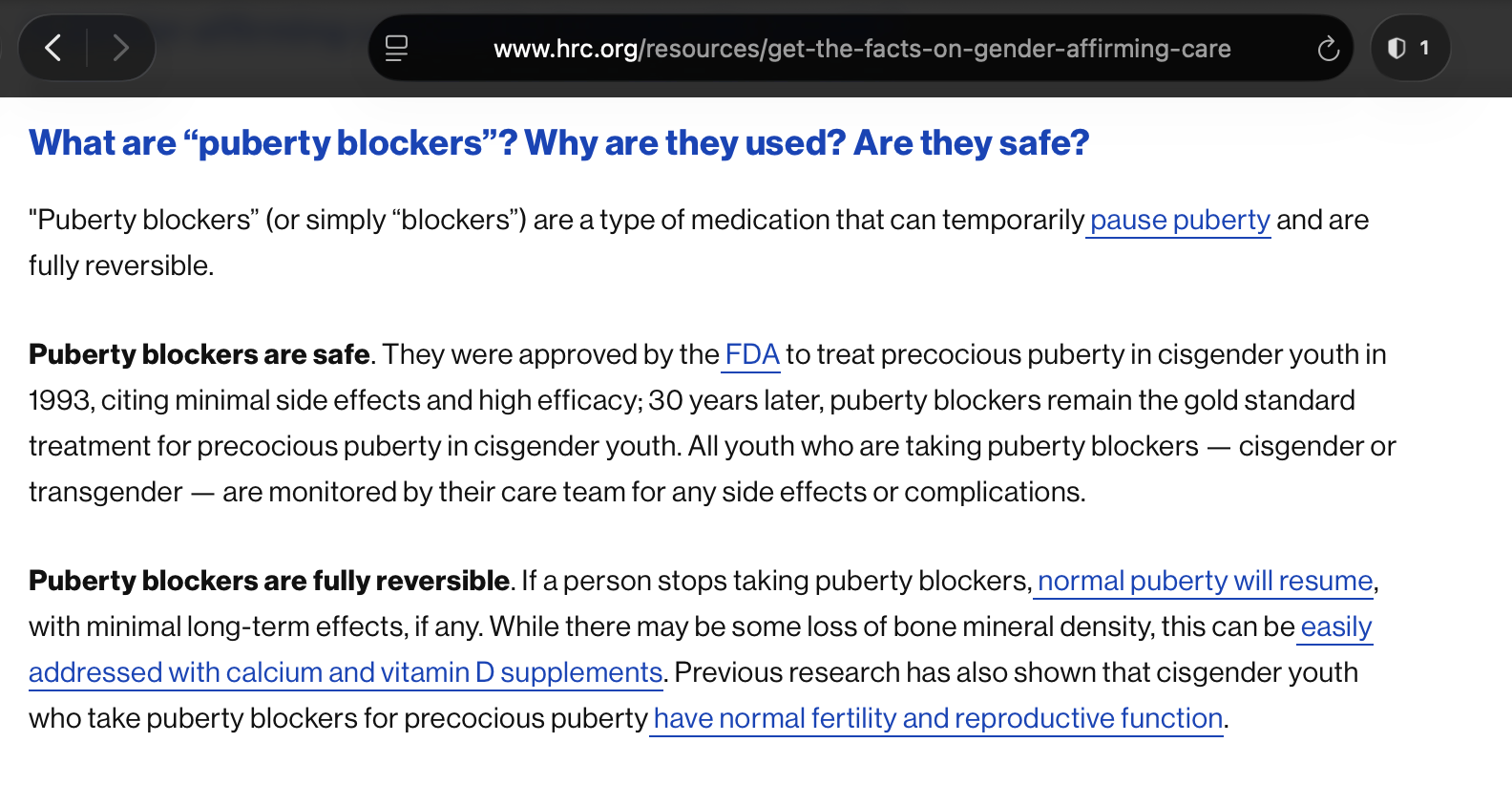
Proponents of pediatric gender medicine have long claimed that puberty blockers are “completely reversible.” In fact, there are growing concerns regarding the use of puberty blockers to suppress physiologically normal puberty.
First, there are emerging signals that puberty blockade could harm brain development and bone density.
→ The impact of suppressing puberty on neuropsychological function: A review
→ The effect of GnRH analogue treatment on bone mineral density in young adolescents with gender dysphoria: findings from a large national cohort
Second, there is reasonable concern that the suppression of physiologic puberty may prevent the natural resolution of gender dysphoria that has historically accompanied the trajectory through adolescence for most children. For example, 88% of boys with a childhood gender identity disorder in one study no longer had gender dysphoria in adulthood.
By contrast, typically 90% of adolescents started on puberty blockers continue on to cross-sex hormones — a rate that calls into serious question the “pause button” framing.
Finally, when puberty blockers are given when a child reaches Tanner Stage 2 — which is a common plan for children with gender dysphoria who have been socially transitioned in childhood — the likelihood of complications from cross-sex hormones and surgeries is higher. A natal female who starts testosterone after she finishes puberty may well regain her fertility if she stops testosterone. However, by suppressing pubertal development in the ovaries and then starting testosterone directly, the ovaries will often become sclerotic, and permanent infertility will result. A similar process transpires in the testes. A natal boy who starts puberty blockers at Tanner 2 and then proceeds directly to estrogen therapy is likely to never reach sexual maturity and may never be able to achieve orgasm.
Due to the lack of penile tissue in natal males who undergo puberty blockade at Tanner 2, penile inversion vaginoplasty — the standard technique for adult men who have completed puberty — is often not possible. Alternative techniques carry higher complication rates. One of the original 70 patients in the Dutch puberty blocker cohort died due to complications of a vaginoplasty requiring use of the sigmoid colon.
Isn’t it a myth that minors are getting surgeries?
This is not a myth. The most common surgery in pediatric gender medicine by far is mastectomy for natal girls, which has been performed for gender dysphoria in girls as young as 12. Orchiectomy and vaginoplasty have been performed under the age of 18 as well.
It is somewhat difficult to know how many of these surgeries are performed in the United States, as they have not been tracked by any clinical trial or regulatory body. Medicaid and private insurance claims databases provide some information, although they cannot account for surgeries performed in integrated managed care systems like Kaiser Permanente or paid for privately. One study found that 3,215 patients between the ages of 12 and 18 received surgical breast or chest procedures for gender dysphoria between 2016 and 2020, based on extrapolation from a limited data set.
Major medical organizations still support these treatments. Doesn’t that consensus mean something?
Professional societies including WPATH, the American Academy of Pediatrics, and the Endocrine Society have issued guidelines supporting pediatric gender medicine, and it is reasonable to ask whether their consensus should be dispositive. However, a closer examination reveals that these guidelines were not produced through the systematic review process that governs most evidence-based clinical recommendations.
The AAP’s 2018 policy statement, which has driven much of American pediatric practice, was authored by a single physician and was not subjected to the AAP’s standard evidence review process. It cited no systematic reviews and relied heavily on expert opinion. The AAP’s own members subsequently submitted a formal request for a systematic evidence review, which the organization declined to conduct.
WPATH’s Standards of Care have faced similar scrutiny. Unsealed court documents in American litigation, reported by The Economist, revealed that WPATH leadership actively worked to remove age minimums and exclude findings on insufficient evidence from its published guidelines.
By contrast, every independent systematic review commissioned by a national health authority — in the United Kingdom, Sweden, Finland, Denmark, and Norway — has reached the same conclusion: the evidence base for pediatric medical gender transition is insufficient to support its routine clinical use. These are not politically motivated findings. They are the result of applying standard evidence-grading methodology to the existing literature.
For more on institutional failures in this space, see: lgbcouragecoalition.org/the-medical-scandal/failed-institutions/
What about the Cass Review? Does it apply to the United States?
The Cass Review, commissioned by NHS England and published in April 2024, represents the most comprehensive independent evaluation of pediatric gender medicine ever conducted. Led by Dr. Hilary Cass, a former president of the Royal College of Paediatrics and Child Health, the review examined over fifty years of published research and concluded that the evidence base for medical transition in adolescents is remarkably weak.
Advocates for pediatric gender medicine have argued that the Cass Review reflects specifically British healthcare conditions and cannot be applied to American practice. This argument does not hold up to scrutiny. The Cass Review was a systematic evaluation of the international research literature — the same published studies that underpin clinical practice in the United States. Evidence that is insufficient in England is insufficient in Ohio.
What does differ across health systems is not the evidence but the institutional culture surrounding it. The UK, Sweden, Finland, Denmark, and Norway have all had the capacity to conduct independent evaluations precisely because their centralized health systems are not dependent on the continuation of these services for revenue. The United States has not yet conducted an equivalent national review.
Isn’t informed consent a sufficient safeguard?
Informed consent is a cornerstone of medical ethics, and it is reasonable to ask whether robust consent processes can adequately address concerns about pediatric gender medicine. The evidence suggests that informed consent in this field has been systematically compromised.
First, informed consent requires that patients be given accurate information about risks and benefits. For decades, families were told that puberty blockers were “completely reversible” — a claim that cannot be substantiated. Consent obtained on the basis of inaccurate information is not ethically valid consent.
Second, adolescents and their parents cannot consent to risks that are unknown. The long-term effects of puberty blockade on neurological development, bone density, and fertility were not studied before these treatments became widespread pediatric practice. Medicine does not ordinarily expose patients to unstudied risks on the basis of optimistic assumptions.
Third, informed consent cannot resolve the fundamental clinical question of whether a given treatment is appropriate for a given patient. A clinician who has good reason to believe that a patient’s gender dysphoria would resolve without medical intervention is not relieved of that concern by obtaining the patient’s signature on a form.
What about patients and families who report that these treatments helped?
The clinical experiences of patients and families who feel they have benefited from pediatric gender medicine are real and deserve to be taken seriously. They do not, however, constitute evidence of efficacy. Medicine abandoned reliance on uncontrolled patient-reported outcomes for important treatment decisions for well-established reasons — among them, placebo response, regression to the mean, and the difficulty of separating treatment effects from the benefits of increased clinical attention, family support, and community belonging that often accompany enrollment in gender medicine programs.
The populations presenting to pediatric gender clinics have also changed substantially since the early Dutch cohort studies that initially suggested benefit. Today’s patients are more likely to be adolescent females with co-occurring mental health diagnoses — a profile that differs significantly from the predominantly male childhood-onset gender dysphoria patients on whom early research was conducted. It is not appropriate to generalize findings from one population to another.
Why do gay and lesbian people care so much about this issue?
Because we have seen this before.
Gay men and lesbians have a particular vantage point on the medicalization of gender nonconformity — because for most of the twentieth century, we were its primary subjects. Homosexuality was classified as a mental disorder until 1973. The clinical and institutional apparatus that existed to identify, treat, and normalize gender-nonconforming children was, in practice, an apparatus designed to produce heterosexual and gender-conforming adults. The methods changed over the decades. The underlying logic did not.
What the research has consistently shown — and what the original Dutch researchers who developed puberty blockade protocols understood — is that the overwhelming majority of children who present with gender dysphoria or gender nonconformity will, if left to move through adolescence without medical intervention, grow up to be gay or lesbian adults who are comfortable in their bodies. Studies following these children longitudinally have found desistance rates of 60 to 90 percent.
The children who are most likely to be referred to gender clinics today — those who are same-sex attracted, gender nonconforming, sensitive, and struggling socially — are, statistically, much more likely to grow up to be gay or lesbian adults than transgender adults.
This matters clinically. A diagnostic framework that does not adequately account for the developmental trajectory of gender-nonconforming gay and lesbian youth — and that moves quickly toward irreversible medical intervention — is not a neutral framework. It has predictable and disproportionate effects on a specific population. Many gay and lesbian adults who came of age before this clinical moment recognize the children now being referred to gender clinics. They recognize the distress. They recognize the nonconformity. And they recognize, with some urgency, that the pathway now being offered to those children would have been offered to them.
The concern is not abstract. It is not political. It is the concern of people who understand from lived experience what it means to be a gender-nonconforming child in a world that is made uncomfortable by your existence — and who believe that the answer to that discomfort is not a medical file.
For Further Reading
→ Jamie Reed, “How a Small Gender Clinic Landed in a Political Storm,” The New York Times (August 2023) — The Times’ investigation into the Washington University pediatric gender clinic that corroborated core elements of the whistleblower account that led to the founding of LGB CC.
→ Jamie Reed, “I Thought I Was Saving Trans Kids. Now I’m Blowing the Whistle,” The Free Press (February 2023) — The original whistleblower account from LGB CC’s Executive Director.
→ The Cass Review: Final Report (April 2024) — The most comprehensive independent evaluation of pediatric gender medicine ever conducted, commissioned by NHS England. Examines over fifty years of published research. Essential reading for any clinician who wants to evaluate the evidence base directly.
→ Society for Evidence-Based Gender Medicine (SEGM) — segm.org — A hub resource designed specifically for clinicians, aggregating the international systematic reviews, regulatory decisions, and peer-reviewed literature in one place. The best single destination for a physician who wants to keep reading.
→ “A Follow-Up Study of Boys With Gender Identity Disorder,” Frontiers in Psychiatry — An academic overview of how gender non-conforming boys were treated historically, describing the once well-established phenomenon that the vast majority desist by the end of adolescence.
→ “Research Into Trans Medicine Has Been Manipulated,” The Economist — Based on unsealed court documents in an American gender medicine case, The Economist reports on the manipulation of pediatric gender medicine research by WPATH. (Free access via SEGM.)
→ Benjamin Ryan, “How Gender Medicine Set Itself Up for Disaster,” Compact — A longtime HIV journalist and gay man evaluates a trove of WPATH conference videos.
→ Finnish study on mental health outcomes in gender dysphoric adolescents, Acta Paediatrica (2025) — Demonstrates worsening mental health in gender dysphoric adolescents treated medically, compared to controls.
→ HHS Report on Gender Dysphoria in Minors (November 2025) — A comprehensive overview of the state of pediatric gender medicine. Many healthcare professionals will be skeptical of this report given its origin in the Trump administration. The authors are, however, a politically diverse group that leans left if anything — all are subject matter experts who delivered a thorough, well-sourced review.
What Can I Do From Here?
We have two pathways below depending on your situation. If you are a clinician encountering this evidence for the first time, the first section is for you. If you currently work — or have worked — inside a gender medicine program, the second section speaks more directly to where you are.
For Clinicians Encountering This Evidence
From easiest to hardest:
1) Join the LGB CC newsletter. It’s free, although a paid subscription supports the work we do: https://lgbcouragecoalition.substack.com/subscribe
2) Contact us directly. If you have questions, want to connect with other clinicians in this space, or want to share your experience, we want to hear from you.
3) Speak up within your institution. Ask whether your clinical program has conducted its own evidence review. Request that grand rounds or continuing education include the systematic review literature from the UK, Scandinavia, and Finland. You do not need to have a public position to ask a question in a department meeting.
4) Contact your professional society. If your specialty organization has endorsed pediatric gender medicine without conducting a systematic evidence review, ask why — in writing, on the record. Member voices matter more than most clinicians realize.
5) Speak up publicly. Prominent voices are still claiming the science is settled, even as it becomes more and more clear that there was never much science involved in this field at all. It is the responsibility of ethical healthcare professionals to demand that claims of “evidence-based” medicine carry some underlying meaning. Write to a journal. Testify. Publish. We can help connect you with the right venues and people.
What Can I Do From Here If I Work — Or Have Worked — In Gender Medicine?
For Clinicians Currently or Formerly Inside Gender Medicine
If you are reading this page and you work inside a gender medicine program, or recently left one, you are in a different position than most of the clinicians this page addresses. You may have seen things that troubled you. You may have raised concerns that went nowhere. You may be wondering whether what you observed was as serious as it felt — or whether anyone would believe you if you said so. You may simply be exhausted and not sure what the next right thing is.
We know this position. LGB CC was founded by someone who lived it. You are not alone, and there is no pressure here to do anything before you are ready.
From lowest to highest stakes:
1) Read and listen privately. Before anything else, give yourself permission to take in the evidence without having to do anything about it. The For Further Reading section on this page is a starting point. The Informed Dissent podcast, co-hosted by LGB CC’s leadership, covers ongoing developments in this space in depth and is available wherever you listen to podcasts. Nobody needs to know you’re here.
2) Contact us confidentially. If you want to talk to someone who has been where you are, we can make that connection. LGB CC has relationships with clinicians who formerly worked in gender medicine and who are willing to speak privately with people navigating this moment. There is no expectation that a conversation leads anywhere.
3) Document what you have observed. If you are currently practicing and have concerns about patient care, begin keeping a private, contemporaneous record — dates, clinical decisions, your own expressed concerns and how they were received. Do this for yourself, not for any external purpose. If you ever decide to take further steps, documentation of what you witnessed and when will matter. LGB CC can help you think through what to document and how. Consult a personal attorney before sharing any records or patient information externally — whistleblower protections are real but vary by state and circumstance.
4) Raise concerns through available internal channels. Most institutions have mechanisms for raising clinical concerns — department leadership, ethics committees, patient safety reporting systems. These channels are imperfect and we have no illusions about the institutional pressures that operate in this space. But using them creates a record, and a record matters. Put concerns in writing. Keep copies.
5) Report to external bodies. Clinicians have reporting options beyond their institutions. The FDA’s MedWatch program accepts adverse event reports from healthcare providers. State medical boards and, in some circumstances, state attorneys general offices accept complaints about clinical practice. If you have witnessed conduct that you believe constitutes fraud — including in research contexts — federal and state whistleblower statutes may provide both protection and legal recourse. Consult a personal attorney before taking formal external steps.
6) Tell your story. When you are ready — if you are ever ready — your account matters. The public record on what has happened inside gender medicine programs in the United States is still incomplete. Clinicians who speak from direct experience carry a credibility that no external critic can replicate. LGB CC can connect you with journalists, legal resources, and advocacy organizations who work with clinical whistleblowers. We will not push you toward this step. But we want you to know the door is open.